
Wonderful World Of Warblers
STORY LYNNE RICHARDSON | PHOTOGRAPHY NIGEL EVES
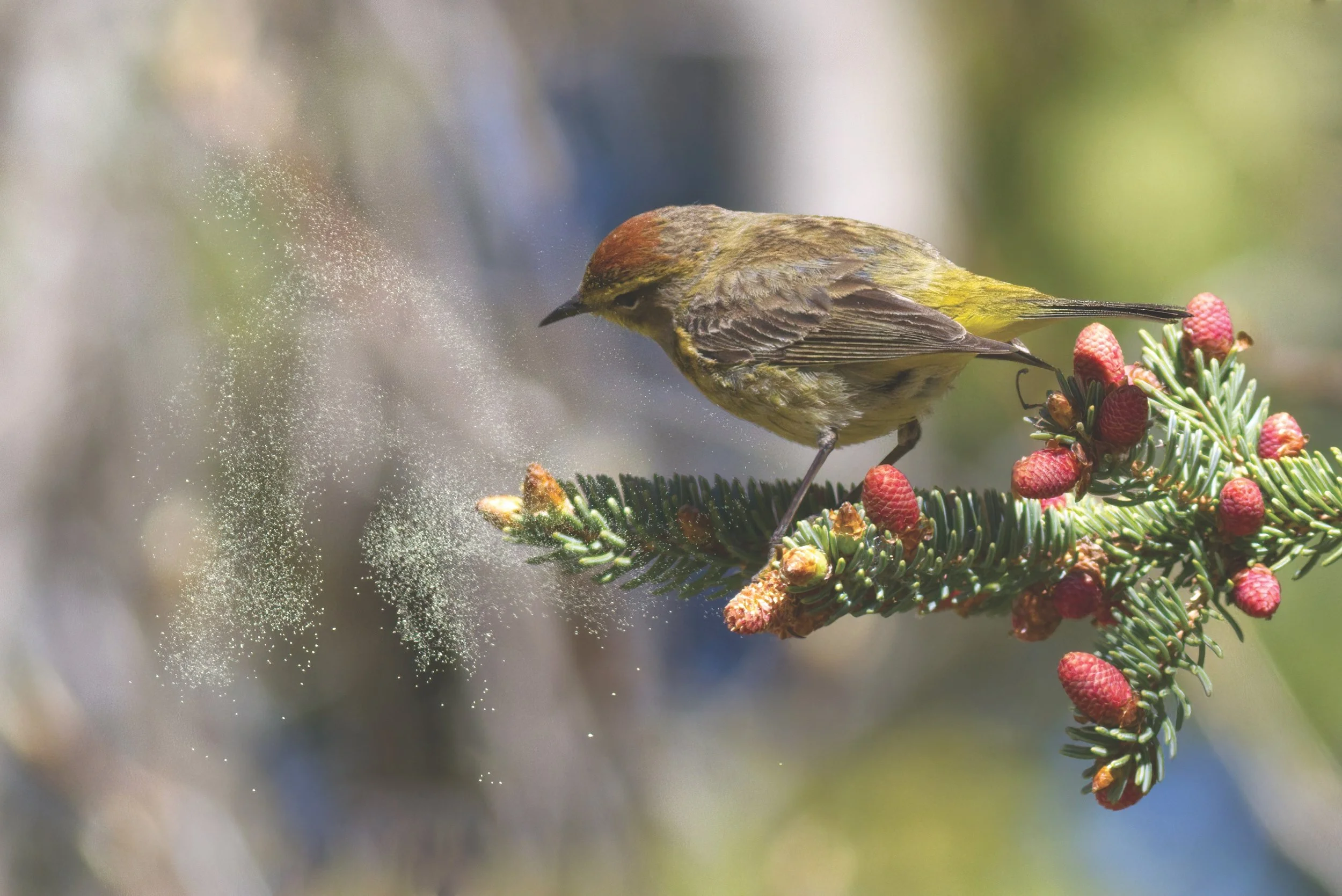
Palm Warbler
HIDDEN GEMS
Spring is in the air. Literally. Birds, those welcome harbingers of spring, are on the wing in the skies above us on their annual migration mission to Canadian breeding grounds. Hundreds of species are returning and tucked among them are a lesser-known family of birds that are most coveted by birders. They’re a range of brightly coloured species often referred to as the “jewels” of the bird world – the fabulous family of warblers.
A WARBLER PRIMER
Warblers, or Wood-Warblers according to their official taxonomic classification, are colourful songbirds unique to the Americas. Over 30 species occur or breed in Ontario. Some of them are among the most abundant species of birds in our vast forests. They tend to come in waves as they migrate together in tight mixed flocks. But for all their numbers, they are not commonly seen. There are good reasons why not. Despite their bright colours, warblers are tiny (smaller than a chickadee). They’re easily camouflaged by branches and leaves. They often forage tucked up high in the treetops. They don’t stay still long enough for a good, identification-worthy look. They keep moving ever onwards in a quest to reach their nesting territories. And finally, by the end of May, the warbler show is over. The waves of warblers have now dispersed widely across the province, each pair ensconced in their own specific nesting-niche territories. With all this, it can very much be a case of “if you blink you will miss them.”
A BOUQUET OF WARBLERS
Warblers, like most birds, migrate at night under the protection and cover of darkness. Come morning, they seek rest and food wherever they may be in their journey north. While the backyards of our homes are not their preferred habitat, they just may drop by after a long night on the wing, to fuel up for the next leg of their migration. So, as we look out the windows of our homes to enjoy the emerging signs of spring, we may be lucky enough to see our backyard trees and shrubs adorned with a “bouquet of warblers” – the collective noun for a group of these birds. Grab your binoculars and check them out for a morning of discovering these little gems.
WHAT’S IN A NAME
So how do you sort out one wee warbler from another? There are so many species, and they don’t stop and pose for you! It can be challenging, but that’s where the fun is. Thankfully, each species does have its own distinctive field marks that distinguish it from its warbler cousins. A number of species even provide clues by virtue of their descriptive names. Notice a black-and-white striped warbler? Well, it’s a Black-and- White Warbler. Completely yellow? It’s a Yellow Warbler. Black throat and blue back? Black-throated Blue Warbler. Gold wing patches? Golden-winged Warbler. The names alone evoke visions of brightness and beauty. But wait until you actually spot one!
And their songs! There is such a range that birders often use mnemonics to sort them out. For instance, the mnemonics for the Yellow Warbler are, “sweet, sweet, I’m so sweet.” Don’t you agree? On the other hand, there’s a group of warblers with decidedly unhelpful names. Tennessee, Cape May and Nashville Warblers, for instance, are denizens of the northern boreal forests, not their namesake locations. Magnolia and Palm Warblers were simply named after the plants they were first discovered in. So don’t rely on those names for identification hints, and don’t think you won’t see them in your backyard.
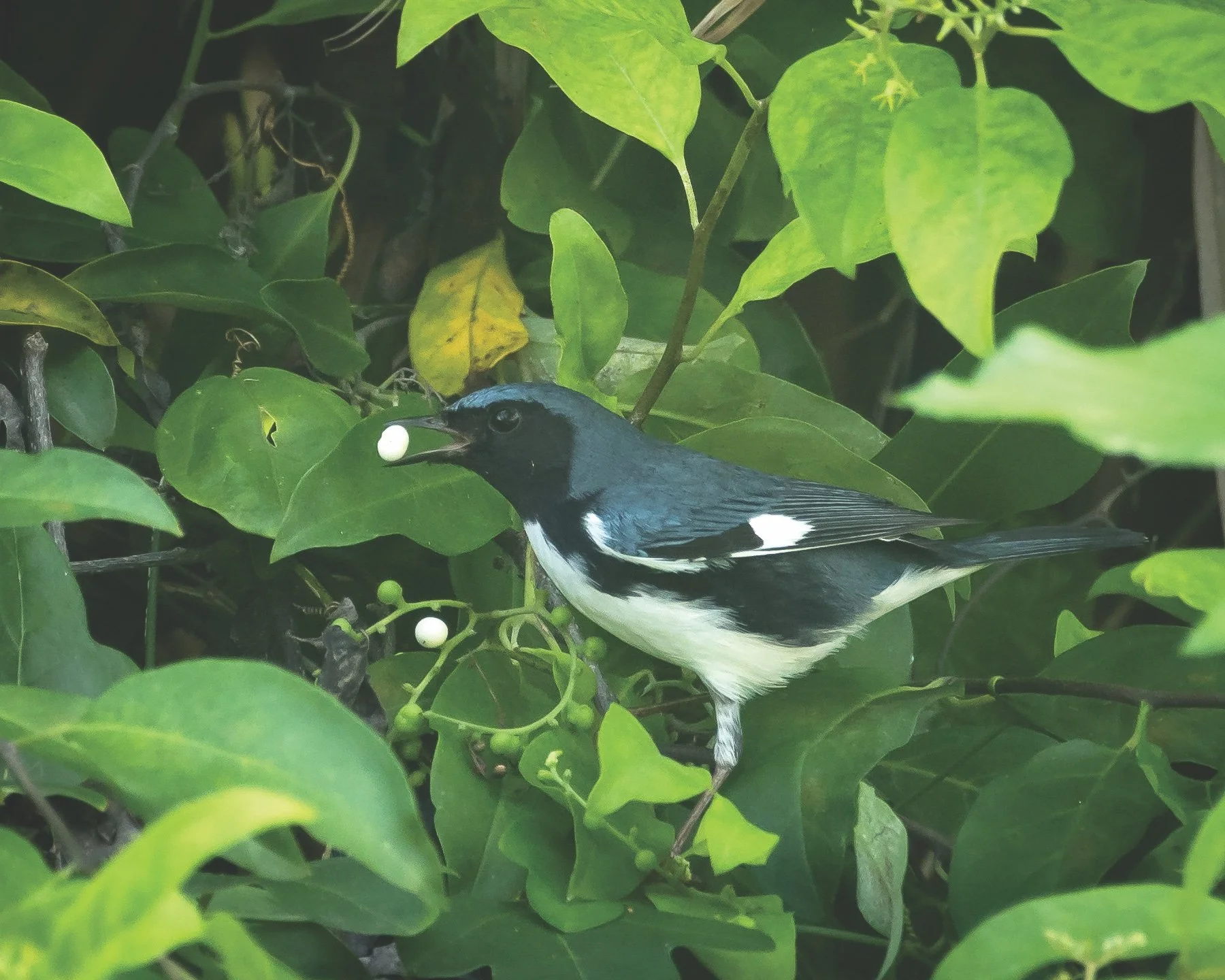
Black-throated Blue Warbler
WARBLER NECK
With a little patience and practice, discerning one warbler from another eventually gets easier, not to mention very rewarding. It is rightly a bit of a personal achievement to positively identify your first Blackburnian Warbler, your first American Redstart – the list goes on and on. Take up the challenge! But be prepared to wind up with a bout of what seasoned birders refer to as “warbler neck.” It’s that tight kink in your neck resulting from scanning high into the treetops for lengths of time, hoping to discover a few hidden bejeweled treasures. At the end of the day, the kink is just a reminder of time well spent in a quest for your new favourite warbler. A few gentle stretches and you’re good to go again the next day.
SPARK BIRD
It is not uncommon for birders to have what is referred to as a “spark bird” – a sighting of a particular species that sparked or triggered their interest in birds and birding. For many, this spark is often a warbler (mine was the oh-so-handsome Bay-breasted Warbler). A good, crisp look through your binoculars at any one of these bright little beauties is often enough to give you that spark and awaken your senses to the wonderful world of warblers. Enjoy! OH
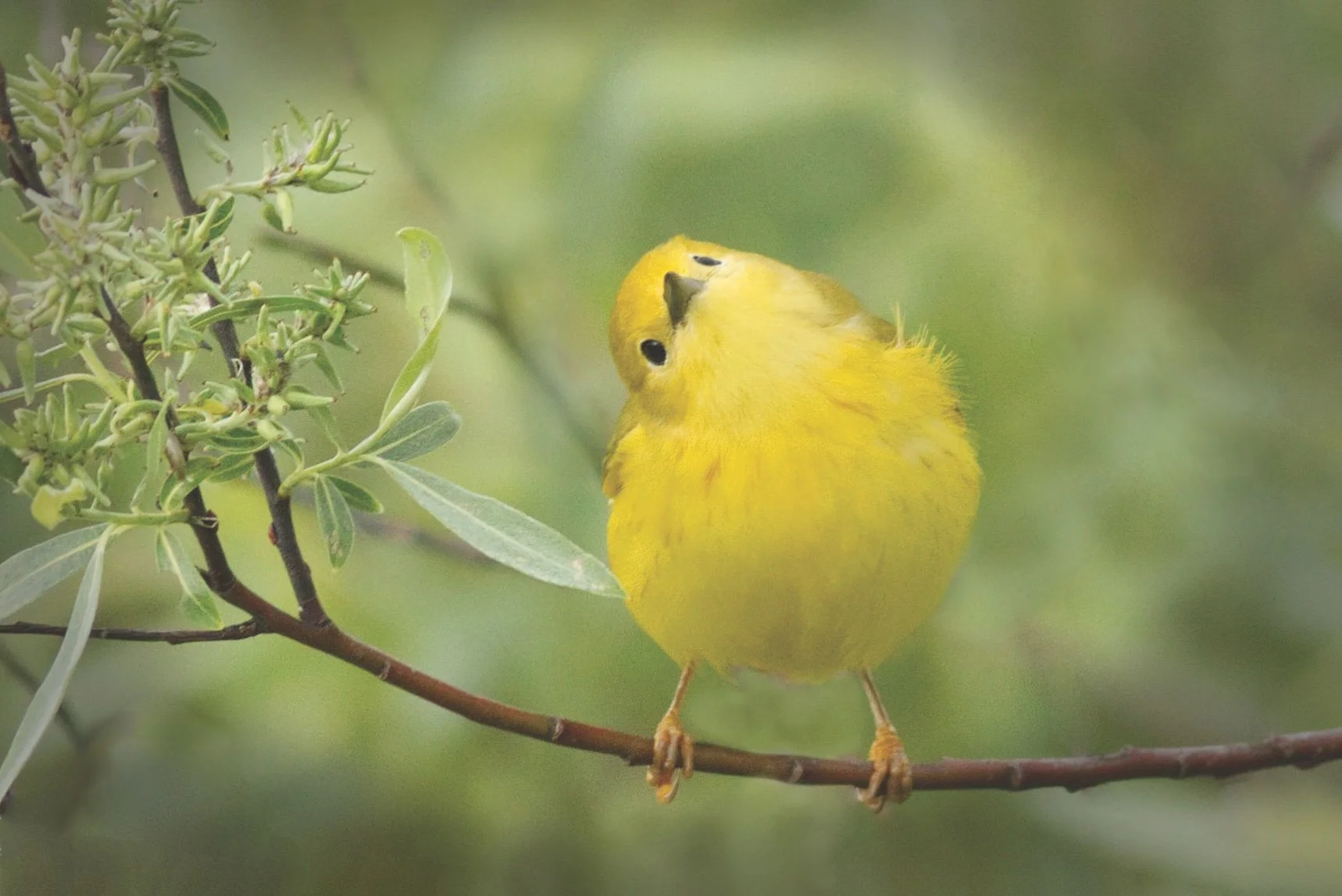
Yellow Warbler