
Plovers In A Dangerous Time
STORY LYNNE RICHARDSON
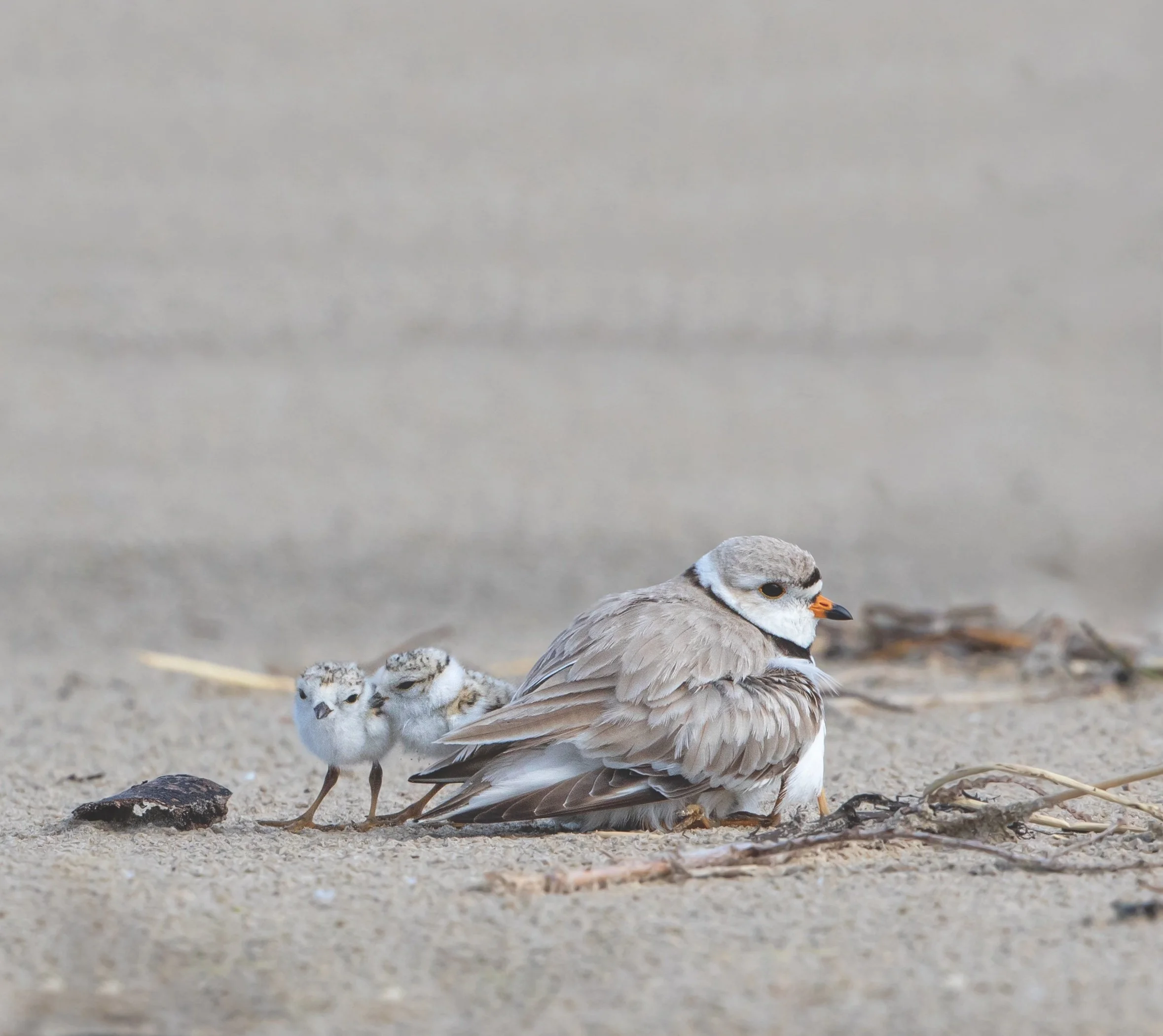
PHOTO: MERRI-LEE METZGER
Generalists and Specialists
Many bird species thrive in Ontario despite the ongoing pressures of habitat loss and degradation, climate change and urbanization. These species are known as the Generalists. They’re not overly fussy about their diet, they are equally at home in rural or urban niches, and they readily adapt to any available nest site. Think robins, starlings, doves, grackles and crows, among others. They’re doing ok!
But many of our birds are not doing ok. These species are often the Specialists – birds that have evolved to be totally reliant on very specific habitat, nesting and food requirements. Without precisely the right conditions, they simply cannot thrive, or even survive.
The Piping Plover
One such specialist species is the Piping Plover, a handsome, charismatic wee shorebird that nests in very small numbers (only 70 pairs, five pairs in Ontario) exclusively on extensive, wide, sandy beaches (no other beaches will do) on the shores of the Great Lakes. These beaches beckon throngs of beachgoers, and the plovers historically had to share the shore with many hundreds of humans throughout their breeding seasons. Piping Plovers nested in Ontario up to 1977, but for 30 years after they were extirpated from Ontario due to competition from intensive human use of beaches, encroaching beach-side development, and general habitat degradation. Consequently, the species was listed as endangered in 1985. But thanks to a combination of intensive site protection, predator control and some captive rearing of abandoned eggs in the U.S., around 25-plus years ago the birds began a bit of a comeback. In 2007, two young Piping Plovers found Sauble Beach (how did they do that!) and each other, and nested!
Because of their status as an endangered species, Piping Plovers are protected when they land on one of our beaches. Being a specialist, the birds will only nest on the sand on the open beach; although in a vulnerable location, that’s just how they’ve evolved, relying on their sandy colouration for camouflage. So, when a nest is found, a predator exclosure cage is set up over the nest, a foraging area is roped off, a shorebird biologist and a group of volunteers monitor the nesting and the chicks and educate beachgoers on the need to share the shore with the vulnerable baby birds and their protective parents. Even so, odds are against a nest surviving the 28 days of incubation, or for the four eggs to hatch, or for all four of the adorable, fuzzy, precocious little chicks to survive to fledge.
But they persist! Should the nest be successful, each chick is leg-banded with multi-coloured bands. These blingy bands allow researchers to track the birds after they leave their natal beach, and from season to season thereafter, should they survive the rigours of being a very tiny bird in a very big world. Occasionally we are lucky enough to track a few over a number of seasons. This was the case with one plucky little plover identified by her bands as Ms. Green Dots.
The Story of Green Dots
Green Dots, named for the green dots on her leg bands, hatched on a Lake Michigan beach in 2015. In 2016, she came to Sauble Beach and pair-bonded with Mr. Lonely. He spent the whole summer of 2015 at Sauble without finding a female friend, hence the nickname. Green Dots and Lonely-no-more soon had four eggs on the go, but partway through the incubation he fell victim to a predator! Green Dots had to abandon their nest as plovers share incubating duties and one parent simply can’t manage alone.
However, the season was still young, the nesting instinct prevailed, and Green Dots soon hooked up with Port Boy, a single bird that fortuitously came late to Sauble looking for love. They nested, but Port Boy was also predated! So Green Dots, at only one year old, had already lost two mates, two nests, eight eggs and eight potential chicks. Such is the life of a Piping Plover.
Mr. Blue Bands
In 2017, Green Dots returned to Sauble Beach and found herself a third new beau, Mr. Blue Bands. They scraped out their nest in the sand and filled it with four big eggs. But there was trouble. Blue Bands was a deadbeat dad. He did not like incubating. Male and female plovers take very equal turns at incubation; Blue Bands however would show up late for his shift. He didn’t like to settle down to business. He would get off the eggs and run about picking up small shells or pebbles, and toss them around! He would stand on the eggs! Once, monitors saw that he had somehow knocked an egg right out of the nest during these antics. However, he bumped it back into place before Green Dots was any the wiser. Despite all this, the four eggs hatched and all four wee, incredibly cute chicks fledged – quite a rare ploverly accomplishment!
A Plover Love Story
In 2018 their love story continued. Green Dots and Blue Bands arrived back at Sauble, on different dates, but after a bit of beachcombing found each other, reunited and renested. Blue Bands had now become a very attentive dad, which is a good thing as plover chicks are a handful! They hatch out and hit the ground running in all directions, often right into paths of trouble. Gulls, Merlins, foxes, dogs, raccoons, and boisterous beachgoers are a daily danger on the beach. Green Dots and Blue Bands had their work cut out for them. Nevertheless, this pair repeated their bond at Sauble again in the summer of 2019.
In 2020, the global pandemic closed the beach for much of the breeding season. When it opened for a few days in June, three plovers were found. Blue Bands was one of them, but Green Dots was not. Perhaps she arrived at Sauble only to find Blue Bands with another plover lover. We’ll never know. However, she was soon relocated on a big beach in Michigan where she found an older male friend. They both returned there the following summer as well. But this pair-bond didn’t last a third year.
In the summer of 2022, Green Dots decided, for whatever reason, to check out a beach in Pennsylvania and remained there with another new suitor. They fledged three chicks. In 2023, she returned to the same beach and to the same suitor, but he was predated shortly after their nesting began. The resilient Green Dots again carried on and found yet another new mate, but sadly, after a relatively long lifetime of dodging all manner of dangers, she too finally met her own demise.
Plover Lovers
Over the course of her eight years, Green Dots had no fewer than six different ploverly lovers. Perhaps Blue Bands was her favourite, or perhaps he was the only plover she could find in the tiny plover gene pool for those three years. While we’re not sure how much true love is involved on the part of the plovers, we know there is plenty on the part of the volunteers and beachgoers who become plover lovers. Stories such as this may be somewhat anthropomorphised, but nevertheless, they are both science-based and melt your heart at the same time. And we only hope that more of these fascinating life histories will be documented for years to come. Wouldn’t it be ploverly? OH