
Hitching A Ride
STORY LYNNE RICHARDSON
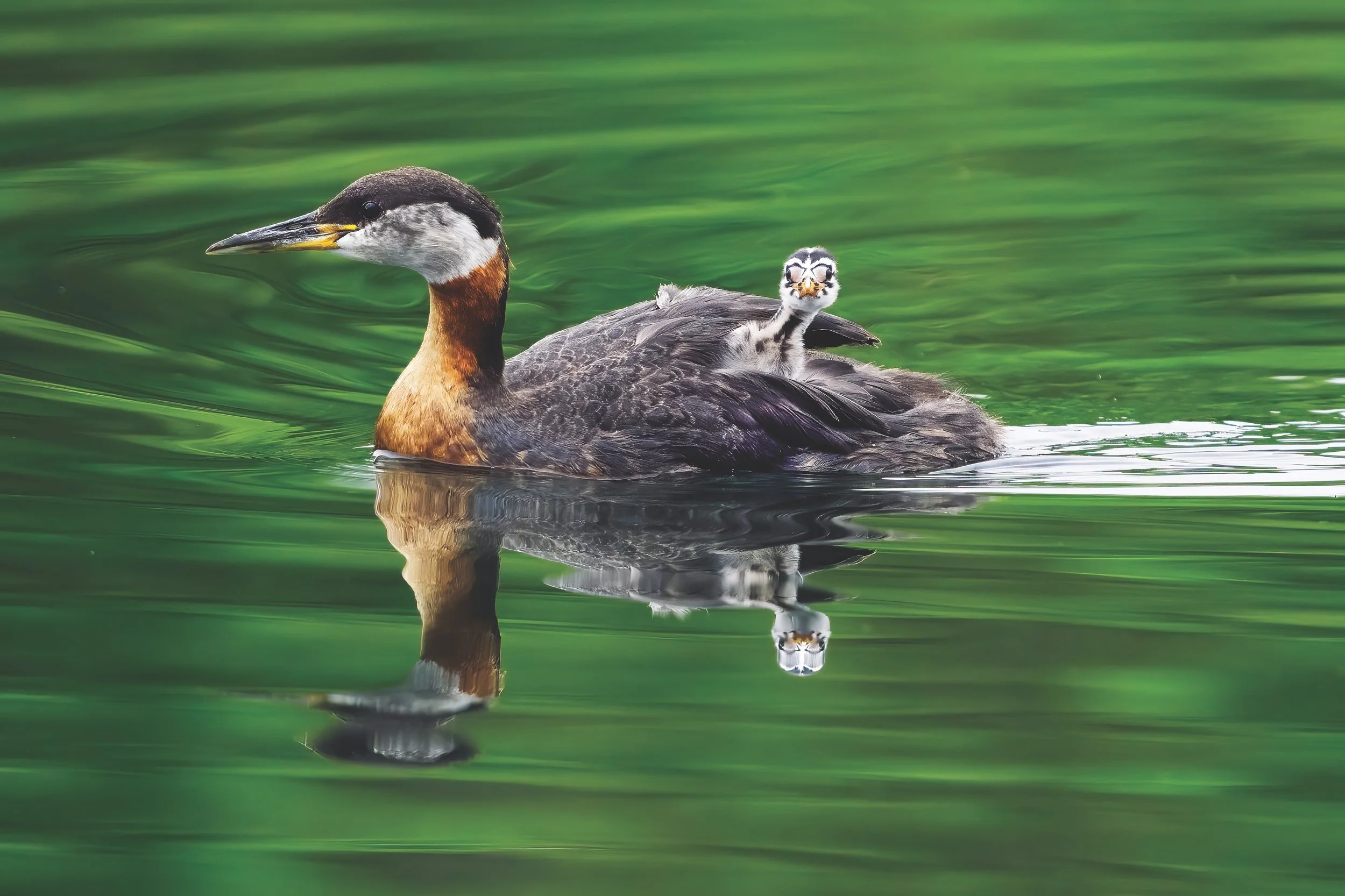
Grebe with Grebette. PHOTO: DALE DARCY
BIRDS BEHAVING CUTELY
Bird behaviour has always been a favourite part of birdwatching for me. Courtship displays, foraging techniques, a territory being vigorously defended by a feisty wee ball of feathers, and a wide range of other avian action adds interest to your observations and provides insight into the secret life of birds.
Behaviour watching can also provide some of the most rewarding sightings and photo ops. Picture this: A mother duck swims into view. Following close behind are a string of downy ducklings. Your interest level rises; baby birds are always appealing. Click, click, you get a picture with your camera – or in your mind’s eye. You’re about to carry on with your birding day when you notice the row of ducklings is shorter. Where did the others go? Then you see them. A few have scrambled up onto the mother’s back! The cuteness scale just shot up! Witnessing a moment such as this is one of the highlights of the summer nesting season.
ALTRICIAL OR PRECOCIAL
Summertime is a busy time for birds. Songbirds have nests full of baby birds that hatch out featherless, helpless and completely incapable of surviving on their own. These nestlings are classified as altricial young, meaning they require much feeding and nurturing to maturity. They are also, let’s face it, not cute, with their naked featherless bodies, their big bulging eyes and their oversize gapey beaks.
But not all young birds hatch out that way. Some species crack out of the egg ready to hit the ground running, or swimming. They are the epitome of cuteness with their fluffy feathers and the way they can motor about and feed themselves. These species include the waterfowl family, which are in the precocial class of birds. Precocial comes from the Latin word for precocious and is an apt term for a chick who can swim circles around its parents and practically fend for itself from day one. However independent, these wee birds still require some level of parental protection and guidance to learn strategies for staying warm and conserving their limited energy supplies as they make their way in their big watery world.
PIGGYBACK RIDES
The poster bird for cottage country, and everyone’s favourite, the Common Loon, is beloved for its iconic wails, yodels and tremolo calls throughout the summer. But equally endearing is its habit of carrying the young on their backs for the first few weeks of their little lives. The young loonlets instinctively know they will be safe and warm when up on their piggyback perch. Adult loons are strong, fast paddlers; baby loons not so much yet, so they climb up and snuggle down when they tire or when they catch a chill from paddling about in the cold waters of their natal lake.
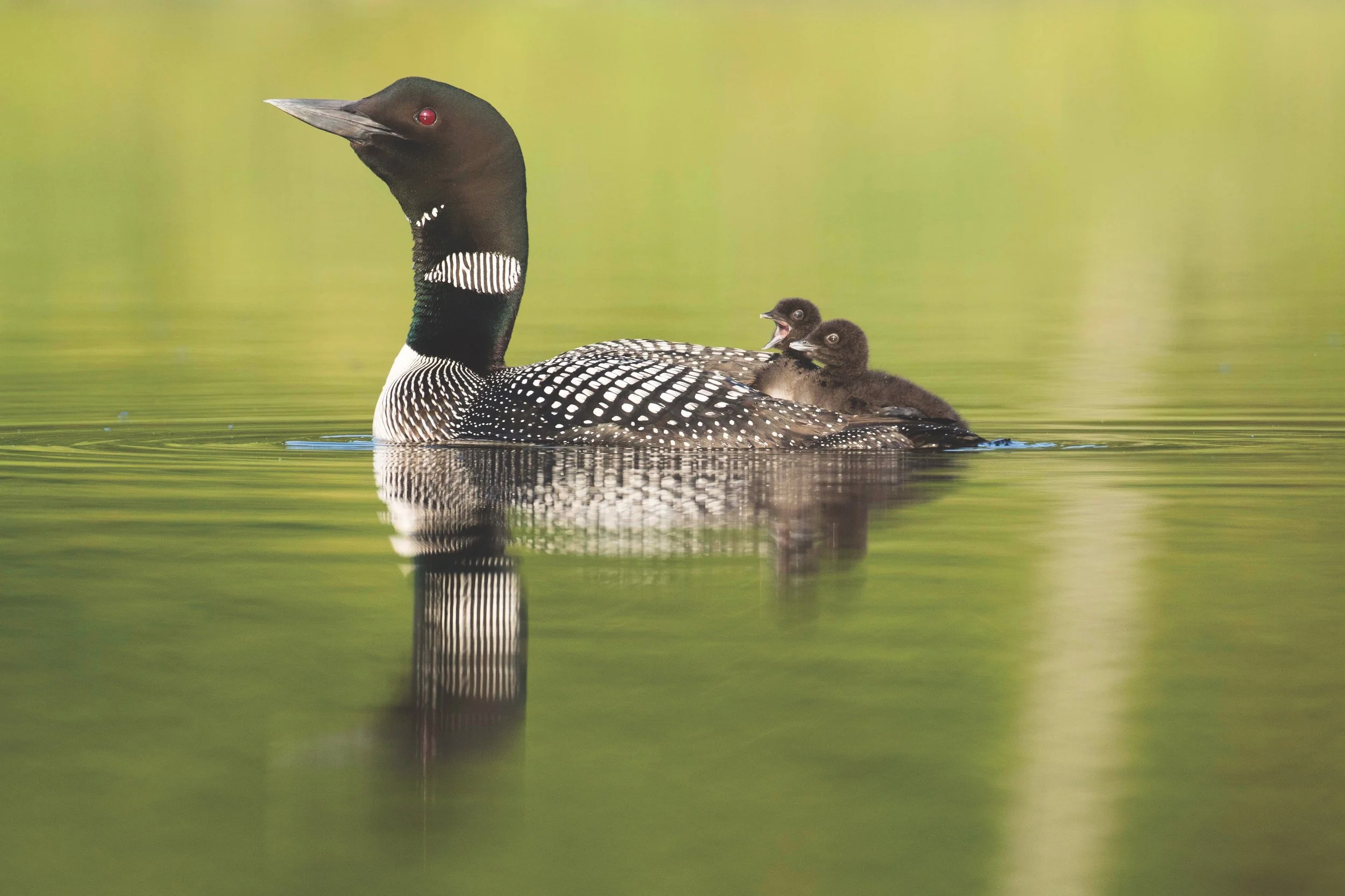
Common Loon with loonlets. PHOTO: MARK PECK
PREDATOR PROOF
Another bonus of catching a ride is the protection it provides from underwater predators. Adult birds can move their young away from danger very quickly by carrying them on their backs. A loonlet’s little legs just can’t paddle fast enough. And by remaining in the water, the chicks’ feet are dangling down rather enticingly in front of a lurking fish, snapping turtle or even a mink. Better to jump on the fast-moving mama’s back and get outta there in a hurry!
GETTING YOUR DUCK(LINGS) IN A ROW
Hitching a ride isn’t the only energy-saving strategy in the baby duck repertoire. They soon learn that swimming all in a row behind their mama is easier than swimming in a bunch behind her. There’s physics at work here. The V-shaped wake the mother duck makes as she swims along forms a tiny wave the ducklings can surf down the sides and into the trough below. This wave energy gives them a wee push forward and the ability to keep up with their fast-moving mother. Each duckling down the line seems to know where to precisely position itself to get the benefit of the next ripple in the wake. That’s why the ducklings are so evenly spaced out in their row and this perfect symmetry makes for such an appealing scene.
SNUGGLE DOWN
Even fully-feathered precocial baby birds aren’t totally able to regulate their body temperature at first. For the first few days after hatching from their warmly incubated egg, the chicks of some species will simply scramble onto the patient parent’s back and snuggle down into its thicker, warmer feathers. They’ll even do this on the nest, perhaps getting ready for the parent’s launch into the lake. This back-brooding is common with the Pied-billed Grebe and again provides such appeal to birders’ eyes and camera lenses alike.
BIG BIRD
Nature is full of surprises. It turns out piggyback rides are not limited to just the waterfowl family. The Sandhill Crane is a big bird; more than one-metre tall, with long legs that raise it over the tall vegetation of its marsh-and-meadow habitat. Their young on the other hand – known as colts – are but centimetres tall at hatching and somewhat unequipped to keep up with their long-legged parents. The short wee colt (so named because of its ability to run around right after hatching like a young member of the horse family) is not averse to taking it easy when it can. So why not hitch a ride and get a bird’s-eye view of its domain.
As a bird behaviour buff, I highly recommend an early morning paddle or stroll along the beach, camera or binoculars at the ready, for a chance glimpse into the life of a baby loon, grebe, or merganser, or any other gift nature may present you with. It’s time well spent. OH