
Modern Family
STORY LYNNE RICHARDSON
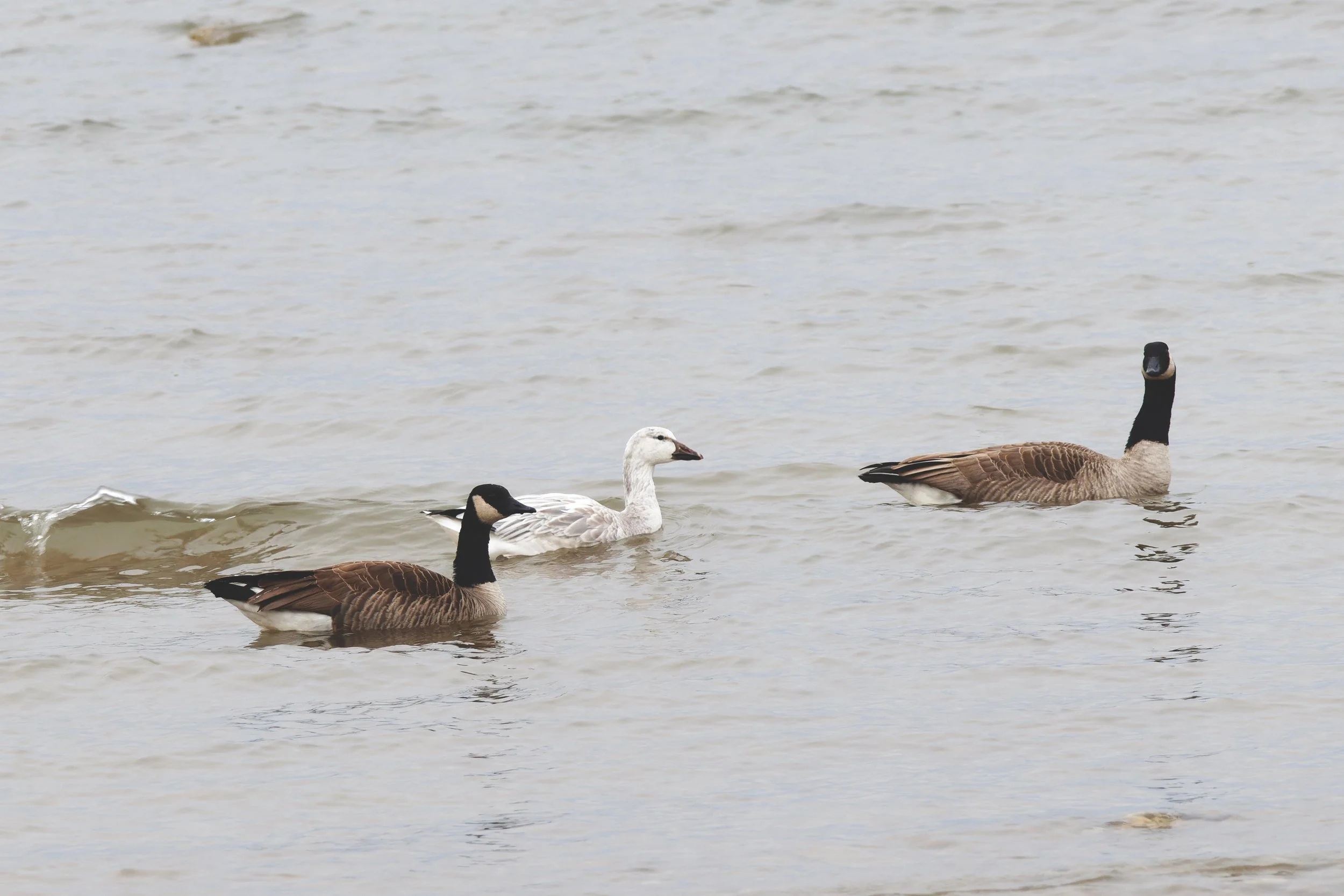
PHOTO: NIGEL EVES
Nature, as they say, never ceases to amaze, and is full of surprises. Take a commonplace species – the Canada Goose for instance – and think, what could be intriguing about it? They appear to do nothing more than graze on golf courses, park lawns or your lawn, and otherwise just loaf on lakes or in fields. However, I recently had a chance to look deeper into the everyday lives of a pair of Canadas, and discovered all was not as humdrum as you might think.
THE CANADA GOOSE
Canada Geese, as we all know, are our most familiar and abundant waterfowl, found virtually everywhere across Ontario. Their numbers have proliferated in sync with the proliferation of big, lush lawns, grassy golf courses and pastoral public parks, which provide them with the perfect combination of both their favourite food and openness, which offers predator protection. These human-made habitats are so suitable that in some areas, the geese stay year-round instead of migrating as nature intended. Canada Geese are known to mate for life. Goslings stay with their parents throughout their first year. Come fall, families group together socially at reliable food sources. Nice, but nothing too glamourous here.
THE SNOW GOOSE
The Snow Goose is another abundant, though lesser-known goose species. These hardy geese breed above the tree line in the Canadian Arctic and migrate in a blizzard of whiteness by the thousands through eastern Ontario in autumn to southern wintering destinations. But each year, if you are looking, you’re bound to notice a handsome pure white goose with black wing tips mixed in with a flock of Canadas. Although Snows and Canadas don’t migrate together and tend to not associate where their breeding grounds overlap, a few stray Snows inevitably end up off-course and will then accept Canadian company until they get back on track.
A GAGGLE OF GEESE
So, this brings us to a day last fall when friends alerted me to sightings of a greyish-white goose at our local waterfront park. I found it easily in the lake and waddling onshore to nibble on the park grass. Its colouration was not the snowy white of an adult Snow Goose, but rather, its white feathering was mixed with greys. This plumage aged it as a young, first-year Snow Goose, hatched somewhere in the arctic in the spring.
Its location made for an easy study, particularly as it was on our daily walking route. Interestingly, after a few days’ observation it became apparent that the Snow was exclusively associating with two Canada Geese. They were a gaggle! Well, not exactly a gaggle, but a definite threesome. They stuck together, despite the presence of other Canadas in the park. They didn’t mingle. They maintained a tight unit together while foraging on land or in the water. They interacted as a typical Canada Goose family unit, swimming or on land with the juvie Snow always between the two adult Canadas in goose-family protective style.
As other Canadas flew in, fed and flew out of the park on a regular basis, I was expecting the trio to disappear with them at some point soon; geese being very sociable in the fall and October being their prime migration time. But they didn’t. In fact, after watching this interaction several times, it became clear that the trio would actually slowly separate themselves from any group that landed around them, and then keep at a distance, away from the others.
NIBBLING ON NIBLETS
The three geese had quite an affinity to the park. Still-green grass was abundant, and the weather was unseasonably mild. They were there every day through October and November. However, one stormy, wintry December morning I looked out my window and found the trio seeking shelter from the storm on the shoreline in front of my place. Resisting my usual rule to not interfere with nature, I went to the freezer and found a bag of Green Giant corn niblets, spreading them on the beach. It was not long before the birds found the niblets, devouring them with great geese gusto. They returned the next day, then continued to show up over the next week. As the niblets ran out, a bag of feed-corn was purchased, (justified so that I could continue this “behavioural research study,” of course)! The Canadas took to it the first time I replaced the soft niblets with this hard corn, but the Snow picked up kernels and actually spit them out! Ptooey! It took him/her a few days to acquire a taste for these harder kernels.
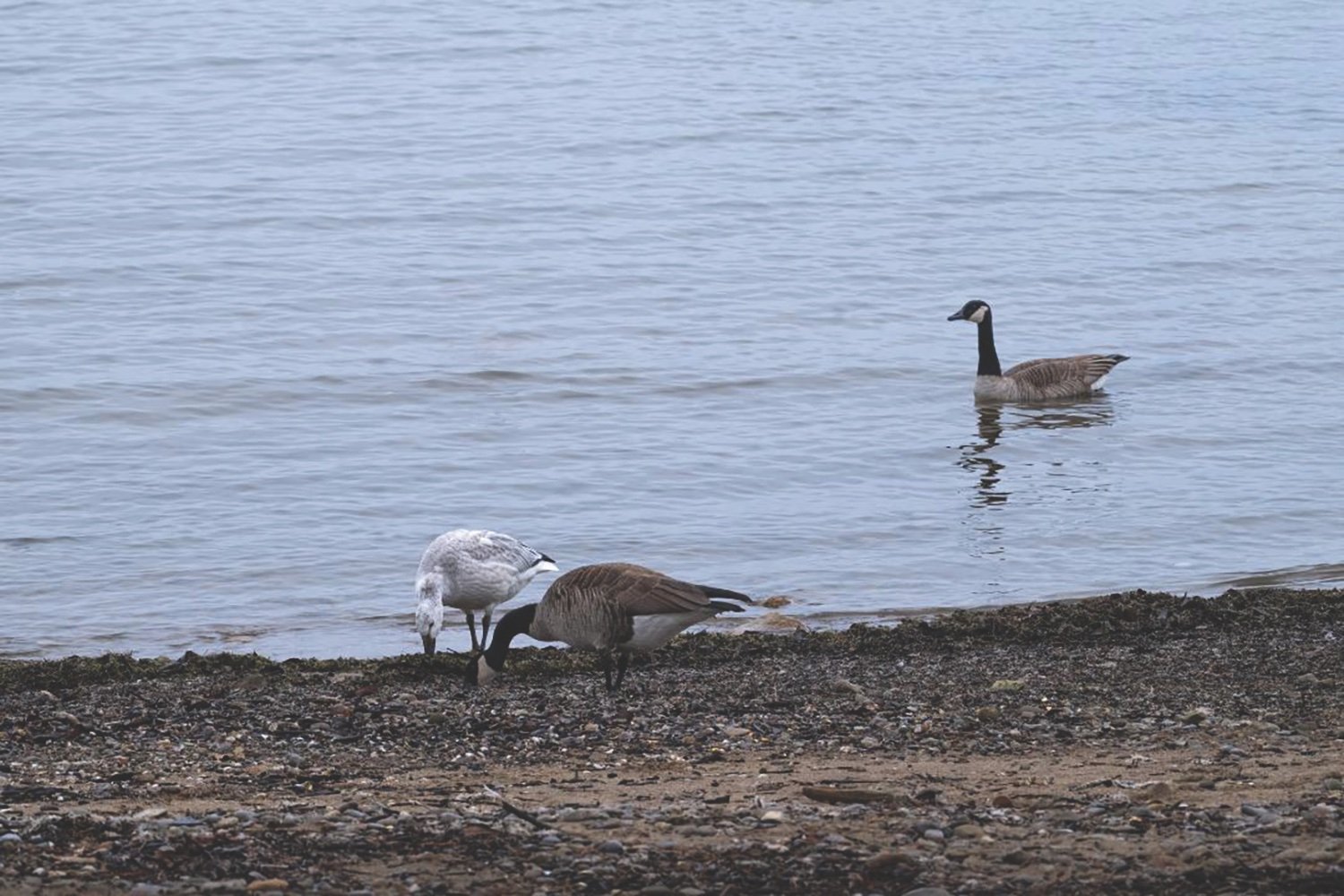
PHOTO: ROBIN JOWETT
GROUNDED
Again, after a few days’ observation, I realized the Canadas appeared daily at the corn by paddling, not flying, from the park. The young Snow would often be alone on the beach first thing in the morning and despite fresh corn being spread out, it would not start to forage. Instead, it would take to the air, fly towards the park, return, only to fly off again. After several such flights, the two Canadas would come paddling in. It seemed that the Snow had to keep connected to the Canadas and check on their progress as they paddled along. Or maybe encourage them to hurry it up?
It was interesting that I never observed the Canadas in flight. They simply paddled from the park. Why not fly, I pondered. A bit of research suggested a late moult, which renders geese flightless for a bit of time, but this flightlessness was now well into winter. Unexplained behaviour indeed.
After a week or two of this pelagic paddling commute, the three geese relocated. They would be walking on my beachfront expectantly, in the dark before dawn, waiting for corn to appear. After breakfast, they would rest and preen on the groynes, forage a bit in the shoreline shallows, or paddle around out on the lake, always returning for their four o’clock feeding.
FOSTER FAMILY
By now I was convinced, based on these observations of their tight bond, and a little research, that the trio was a family group. Adoption of unrelated and extra-species offspring is known to occur in geese. Canada Geese have strong pair-bonds and both male and female are highly attentive parents. This makes for good qualifications for being adoptive parents.
However, with geese it’s been shown that adoption usually occurs when the geese have a gosling brood of their own, which is relatively same-aged as the orphaned adoptee. It seems one more isn’t noticed. But this particular adoption by an adult pair with no existing brood didn’t follow this norm. What accident of nature separated the Snow from its biological parents? How did it happen that a broodless pair of Canadas accepted it? What instinct was at play here? Trying to discover clues to this strange circumstance kept the corn coming…
FLY, FLY AWAY
Whatever brought these three together, they were a bonded modern family through October, November and December. In January however, the Snow began taking frequent short flights away from the Canadas. As days passed, the flights away became longer. Research noted that such flights are indicative of “migratory restlessness.” However, despite the Snow’s restlessness, the Canadas remained firmly flightless.
But inevitably, sometime after their morning corn in mid-January, the geese weren’t loafing about throughout the day. They didn’t paddle up for their four o’clock dinner and the next day no geese were staring up expectantly in the early dawn. It seems the Canadas had finally given into the Snow’s urge to move on.
They left me wondering. Geese return to the same migratory stopover year after year. Has their prolonged stay on Georgian Bay imprinted this location on them for future stopovers? Will I look out one morning next spring or fall to see my Snow Goose, transformed in sparkling white adult plumage, staring up from the shoreline in hopes of another gourmet meal of those soft corn niblets? OH